
The Roman Town House: Dorchester’s Hidden Gem
17th March 2022
The speaker for March’s Archaeology Group Meeting was Steve Wallis, Dorset County Archaeologist.
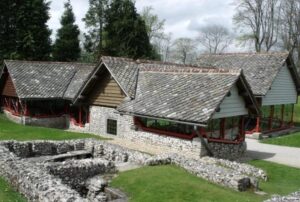 Steve set the scene for his talk on Dorchester’s Roman Town House by tracing the history of Dorchester from its founding by the Roman army in the early AD 40s, through their departure in AD70, the building of defensive banks and ditches to the construction of the townhouse c. AD 300. By this time the town was crammed with buildings, including the huge bath house that now lies under a car park, but abandoned after the Romans left it only had scant occupation during the Saxon period and wasn’t completely full until the reign of Victoria. In the 1700s the defensive earthworks had become obsolete and were turned into boulevards; the northwest section became the boundary wall of Colliton House, an adapted Tudor building sitting in open parkland.
This parkland attracted the County Council seeking a site for new offices and in 1937, prompted by Wheeler’s excavations on nearby Maiden Castle, slit trenches were opened on the proposed site and a wider area where it was intended to put the spoil. It was in this latter area that the townhouse was discovered. It is the only urban domestic Roman site in Britain fully exposed; others have been built over and destroyed but in Dorchester the low level of occupancy and the undisturbed parkland have preserved the remains even at a very shallow depth.
The site was left uncovered during the war, losing various pieces as ‘souveniers’, and after covering over, most of the mosaics were not revealed again until the building of the protective pavilion in 1997. That construction presented its own problems: groundwater flooded the deep hole in which the townhouse now sits and mortar lining the roof became unstable and prone to falling onto the mosaics and anyone inside the building.
This brought Steve up to the latest restoration, designed to improve accessibility both physically to the site and for information about it. An old gate has been re-opened through the Colliton Park wall, which is a Grade II listed building, and an access ramp from the car park has been constructed along the line of the inner bank of the Roman defences. Invasive trees have been removed to improve the view on a new footpath curving around the building, new information boards have been provided and a teaching bank has been installed overlooking the site. The garish colour of the pavilion has been replaced with white, the roof cleaned and most of the dangerous mortar removed. Access to the interior of the building is still only available by arrangement on conducted tours with a guide who will be happy to show off the Roman Town House now that the Council can be proud of the unique building they own.